Movement One: Fire
On generational tethering, severed lineage, and the knowledge that refuses to die.
There is a moment on Kind of Blue, in the opening bars of So What, before Miles Davis has played a single note, where the music is already making an argument. The bass states the theme, the piano responds — and then Miles enters. Not to dominate but to invite. The architecture he builds is spacious enough for other musicians to find themselves inside it. What follows is not a performance of mastery but an act of transmission: a man creating conditions in which other musicians — particularly John Coltrane — can discover what they are capable of.
Miles understood something that most people in positions of authority resist: that your own ceiling rises when you raise someone else toward it. When Coltrane’s solos stretched and searched and refused to resolve neatly, Miles gave him room. Not infinitely, not without the characteristic dry wit — “you might just try taking the horn out of your mouth” — but with a fundamental recognition that Coltrane was working toward something, and that the working itself had value. The lightning bolt needed time to gather charge.
Years later, at Montreux in 1991, Miles would walk offstage mid-performance to hand the spotlight to a young trumpeter named Wallace Roney — a protégé he had mentored for years but never performed with publicly. When he returned and put his arm around Roney’s shoulder, he offered one of the most precise summaries of artistic lineage ever spoken: “I ain’t doin’ shit but playin’ Dizzy’s shit with Freddie Webster’s tone.” He was acknowledging that his own originality was built on foundations laid by others — and in saying it aloud, he was passing that understanding forward. You receive. You hold it. You give it on.
This is what I mean by generational tethering. Not nostalgia. Not the preservation of tradition for its own sake. The living transmission of something essential — knowledge, courage, a way of seeing — from one pair of hands to the next, across fires and across time.
The Four Hills and the Severed Hand.
The Ojibwe teaching of the Four Hills of Life describes the human journey as a passage through four distinct seasons of existence: childhood, adolescence, adulthood, and elderhood. Each hill has its own gifts, its own responsibilities, its own particular way of seeing. But the teaching is not merely a map of individual development. It is a description of a relationship — between the young and the old, between those climbing the first hill and those who have already descended the fourth, between the question and the answer.
The elder on the fourth hill does not hoard what they have learned. They turn back toward those still climbing and offer it. The young person does not simply receive passively — they walk the trap line with their uncle, naming the trees, reading the signs of weather in the sky, learning the natural cycles of life and death not as abstract knowledge but as lived experience accumulated step by step across actual ground. Knowledge here is not transferred through instruction. It is transmitted through presence. Through the walk itself.
Richard Wagamese — Ojibwe writer, storyteller, a man who carried his people’s teaching in his prose with a grace that could stop your breath — understood this in his bones, because he had experienced the catastrophic cost of its absence. Taken from his family at the age of two by child welfare authorities, moved through a succession of foster homes, disconnected from his language and his community and the specific landscape that his ancestors had named and tended and known — Wagamese spent decades finding his way back to what had been severed. His writing is, in the most fundamental sense, the work of a man relearning to walk a trap line that was stolen from him before he could take his first steps on it.
He died in March 2017, too soon, at sixty-one. His native name was Buffalo Cloud.
The Shape of the Journey.
The teaching describes the hills. It does not prescribe their shape.
I have come to understand that no two journeys through the four hills will trace the same geometry — that the incline of one hill will not match the downslope of the next, that what lies between each summit is not a straight path but something more honestly described as a labyrinth: a place of grief and integration, where what was gained and lost in the previous passage must be processed before the next ascent begins.
A labyrinth is not a maze. It has one path. You cannot get lost in it. But the path doubles back on itself before it reaches the centre, and those who do not understand its nature experience it as regression rather than progress. The person walking it feels they are moving backward, covering the same ground, failing to advance. They are not. They are walking the only path there is — the one that requires you to hold your losses before you can lay them down.
I have also come to think that the linear image — four hills in a row, a journey from left to right — is too small a container for what the teaching actually describes. The shape that holds it more honestly is the flower: four petals arranged around a centre, each unique, each necessary, the whole as singular as a fingerprint. No two people’s flowers are the same. The hills may carry the same names, but their proportions, their gradients, the specific terrain between them — these are entirely your own.
And time itself, I have come to believe, is not the line the calendar insists it is. It is a spiral — returning to the same position at a different altitude, the angle familiar, the elevation changed. History rhymes rather than repeats because it is moving through the same angular position on a higher loop. Inherited wisdom travels the same way: from a previous loop of the spiral, received on a new one, the teaching unchanged and the life interpreting it entirely its own. The labyrinth between the hills is where you orient yourself on that spiral — where you look back at the previous loop and forward at the next one, and locate yourself in the continuity of your own becoming.
What the Residential Schools Actually Destroyed.
The violence of the Canadian residential school system — and its counterparts across North America and beyond — is often framed in terms of its most visible brutalities: the physical abuse, the prohibition of language, the deliberate humiliation of culture. These were real and they were devastating. But beneath them lay a quieter, more structural destruction that is harder to name and harder to repair.
When a child was taken from their community and placed in an institution designed to make them ashamed of everything they came from, what was severed was not only their connection to language or ceremony or land. What was severed was the hand-holding across generations — the uncle on the trap line, the elder turning back from the fourth hill, the specific and irreplaceable transmission of how to be alive in a particular place in a particular way. The knowledge that was lost was not stored in books or institutions. It lived in the relationship between the one who knew and the one who was learning. Break that relationship, and the knowledge does not go into storage. It dies.
This is why so many people in our society — certainly not only Indigenous communities, though they have borne the sharpest edge of this severance — move through their lives without being able to locate the ground beneath their feet. They are not failing. They have not taken a wrong turn through some personal inadequacy. The line they should have been holding was cut before they were old enough to reach for it. The saddest part, and the part that matters most, is that those lost souls so often blame themselves. They believe it is something they have done wrong.
It is not. It is something that was done to them. And to their parents. And to their parents before that.
A Rare Night Out, December 2022.
I want to be careful here about the distinction between writing about difficulty and writing through it. What I am about to describe is not offered as confession or as the centrepiece of a wound-narrative. It is offered because it is true, and because the truth of it is directly connected to everything this essay is trying to say.
By December 2022 I had lost, in the space of roughly a year, my career, my marriage, and the version of my identity that had been built around both. The losses did not arrive cleanly, one at a time, in a sequence that allowed for processing. They arrived in layers, compounding each other, each new collapse making the previous one harder to absorb. A decade of investment, of hard work and good faith, had ended in ways I could not reconcile with any logic available to me — not through any failure of effort or intention, but through the particular cruelty of circumstances that have no clean explanation.
The isolation was its own particular weight. I had support in words: messages, vague encouragement, but in the physical, in the actual three-dimensional world, very few people showed up. I have always moved through life with a way of seeing things that sits outside the usual coordinates, and in a period of crisis that difference became a kind of exile. You are visible enough for people to observe that you are struggling. You are invisible enough that they don’t quite know how to reach you. Or perhaps more accurately: you carry yourself with enough quiet dignity through the passage that people mistake composure for stability and leave you to it.
Through those months I found myself returning to two sources of company that existed beyond the living world. My paternal grandfather, Len Revill — a man whose lineage I have been tracing with increasing fascination, following threads that carry a quality I can only describe as a deep resistance: questioning, unwilling to accept what gatekeepers insist must not be examined, holding a quiet refusal to be defined by what the powerful say is permissible. It is a quality I recognise in the tradition his family carried — the chapel culture of the working Midlands, where the idea that a person’s conscience belonged to no institution and no employer was not a radical position but simply how things were. Whether that quality is documented ancestry or simply what gets passed down through the blood without a paper trail, I cannot say with certainty. What I can say is that I recognise it in myself.
The second presence was that of my friend Tom Smithies, who died in 2021, leaving behind a widow and two young children — a loss that shook something loose in me about urgency and purpose and the cost of leaving things unsaid and undone. Tom’s death was not the first time this particular lesson had been delivered. Thirteen years earlier, I had watched another friend die too young, leaving behind a widow and two young children of his own. Steve Harris was a musician of real gifts, a man my father loved in friendship since their schooldays and one who shaped the musical landscape of my childhood in ways I am only now beginning to understand. The same loss. The same shape. The same unanswered questions in the same young faces. When Tom died in 2021, it was as though the universe had decided that the first message had not been received clearly enough, and had chosen to repeat it — same pattern, different name, louder.
Message received. Loud and clear.
What I understood, in the aftermath of that second loss, was that the urgency I felt was not only about making music. It was about making the map. About building the breadcrumb trail. About doing the work — all of it, publicly, carefully, with as much honesty as I could bear — so that if something happened to me, my children would have a way to find me. Not the version of me shaped by circumstances or collapsed by loss or reduced by other people’s narratives. The real one. The artist, the writer, the musician, the man who thought these thoughts and walked this ground and left these traces specifically so that they could follow them when they were old enough to understand what they were following.
This is, I have come to understand, what generational tethering actually asks of you. Not the grand gesture. Not the formal transmission. The daily act of leaving enough of yourself in the world that the people who come after you have something to hold.
Their presence in spirit arrived not in dramatic visitation but in the quiet personal language that the universe develops with you when you become still enough to listen. Specific times on clocks. Symbolic animals appearing at significant moments. Images that arrive with a weight that exceeds their literal content. I am not asking anyone to share this framework. I am simply describing what it was like to move through that time, and what kept me moving.
The Sufi poets understood this. Coleman Barks, translating Rumi, writes that they knew answers might not come in discursive form — but rather in music, in image, in dream, and in the events of life as they occur.
Tom visits still. Not in words — in feathers. Often when I am thinking of him, or in a moment of reflection when the path ahead is unclear, a feather lines the way. In 2023, seeking some form of guidance through the noise, a message arrived that I can only describe as his — a vision of laying railroad sleepers, one by one, building my own track forward on my passage over The Four Hills of Life. Keep going. If you build it, they will come. I have heard that in my inner dialogue more times than I can count since then, and I have chosen to believe it.
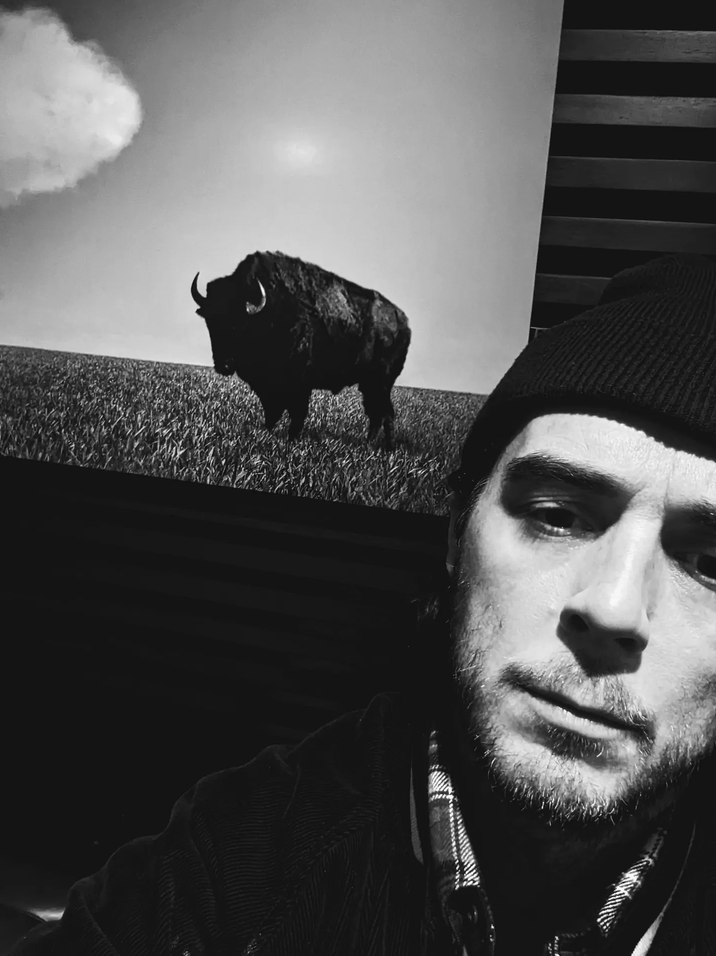
Another message of significance arrived on the evening of Thursday, December 15th 2022. Taking advantage of a rare chance to leave the house that had become a container for so much pain — to go to the cinema, to sit in the dark, to be somewhere that was not the inside of my own difficulty — I stopped to eat at the Cactus Club on Schoolhouse Street in Coquitlam. In the bathroom of that restaurant, on a wall where I was not expecting to find anything, I found a black and white artwork: a buffalo on open plains, a white cloud in the sky above it.
Buffalo Cloud.
Richard Wagamese’s name. There on the wall. Not a coincidence. It was an answer, arriving in the only form it could.
I stood there for a moment that had a different quality to the moments surrounding it. The feeling was not one I would describe as comfort exactly — it was more precise than comfort. It was the feeling of being seen. Not by another person, not in the social sense, but by something that had been watching the whole time and chose that moment to confirm it. You are on the right path. Stay true to yourself. Keep going.
I took a photograph. I was not ready to tell the story. I am now.
Running Into the Storm.
On the open plains, when storm clouds gather and the first cold needles of rain begin to fall, buffalo do not turn their backs and flee. They lower their heavy heads and run straight into the dark belly of the sky. They understand something most of us humans refuse to learn: that the fastest way through a storm is through it. By thundering toward the storm clouds, by meeting the discomfort head-on, they shorten its grip and reduce its power.
So often, we do the opposite. We circle, we stall, we distract ourselves, stretching a passing squall into a season of suffering. That gap between running toward truth and running from it says a lot about who we are. One path demands courage and compresses pain into a moment; the other demands denial and multiplies it over miles. The wise buffalo, in accordance with its nature, chooses brevity over avoidance. We reveal ourselves in the direction we run — because storms pass either way, but what we are made of only becomes visible when we face them.
My maternal grandfather, Arthur Craggs, understood this without ever needing to articulate it. At fourteen, he watched his older brother Ralph’s body brought home and laid out on the dining table — Ralph had been killed in a roof fall at Thornley Colliery, the same mine where Arthur was due to start work two weeks later. Neither Ralph nor the pony he’d been working with had been killed outright; the pony kept struggling, bringing more material down, and Ralph’s workmates could not intervene because ponies were valuable and their actions would have to be accounted for. Arthur’s mother miscarried from the shock of the loss. The family’s grief was compounded by the specific, institutional cruelty of how it had happened.
Two weeks later, Arthur walked into that mine anyway.
He spent his entire working life underground — eventually becoming a ripper and hewer at the coal face, the hardest and most dangerous role, surviving his own roof collapses through sheer physical strength, working until retirement in 1977. He came home from every shift and dressed in his finest clothes. He moved through the world like a peacock in full regalia — not from vanity, but from insistence. The pit did not own him. What the storm demanded of him was not capitulation. It was presence.
I am a Taurus. I have always felt something in the nature of the bull that I recognise in myself — not stubbornness for its own sake, but a refusal to be redirected from what I know to be true. The buffalo intensifies that. The buffalo carries it into the spiritual register.
What We Owe the Living and the Dead.
Wagamese wrote, in Indian Horse and in his memoir One Native Life and in the quiet devastating precision of Embers, about what it means to find your way back to something that should never have been taken from you. His journey was harder than most — the displacement more complete, the severance more institutional, the recovery requiring him to reconstruct almost from the ground up a relationship to his own identity and his own people that had been systematically dismantled.
What he found, on the other side of that reconstruction, was not bitterness — or not primarily bitterness. What he found was a responsibility to pass it forward. To take what had been nearly lost and offer it, in the form of story, to everyone who needed it — not only Ojibwe readers, not only Indigenous readers, but anyone who had ever felt the specific loneliness of moving through a world that did not have language for what they carried.
That is the tradition I want to continue. Not by appropriating what is his — his specific teaching, his specific community, his specific ancestral knowledge belongs to his people and should be sought in his own words — but by carrying the argument forward. By insisting that generational tethering matters. That the line between the elder on the fourth hill and the young person on the first one is not decorative or optional. That when it is severed — by residential schools, by colonialism, by the ordinary modern disconnection of a society that has confused information with wisdom and productivity with meaning — something irreplaceable is lost, and the people who suffer for it are not at fault.
Miles Davis walked offstage at Montreux so that Wallace Roney could find out what he was. Thelonious Monk gave Coltrane a framework inside which the searching could become music. A grandfather walks a trap line with a child and the child learns, without being taught, that they belong to something larger than themselves.
These are not different stories. They are the same story, told in different languages across different fires.
Not everyone finds the turn easy. There are those who walk the fourth hill with full trunks — years of knowledge, decades of experience, stories that belong to others as much as to themselves — and do not yet understand that what they are carrying is not theirs to keep. The hoarding of knowledge is not safety. It is a severance in slow motion. The stories not told, the lessons not offered, the hand not extended — these are losses that compound quietly and arrive, eventually, as absences in the lives of people who needed what was withheld.
I say this without judgment, because I understand the difficulty of turning. The fourth hill, approached honestly, requires a confrontation with everything the previous three have cost — with grief unprocessed, with wounds still tender, with the particular vulnerability of being asked to give from a store that was not always replenished. Some people arrive at the fourth hill carrying not just their own history but the unresolved histories of those who came before them, wounds passed down without names, patterns repeated without recognition. To turn back under that weight and offer the hand anyway — that is not a simple act. It is perhaps the bravest one available.
What I have learned, in my own slow and imperfect practice of this, is that the offering does not require perfection. It does not require that the giver has resolved everything, understood everything, healed everything. It requires only the willingness to turn. To say: here is what I have. Here is what I know. Here is what I learned from the storms I walked into and the ones I tried to outrun. Take what is useful. Leave what is not. The door is open.
The act of offering is itself the healing. For both the one who gives and the one who receives.
There is a quality I have always recognised in myself that I find difficult to name without reaching for frameworks that carry too much freight in the current moment — frameworks that have been captured by movements and agendas I have no connection to and no interest in being associated with. So I will describe it without the label: the refusal to release. The willingness to grapple through the night with something difficult and not let go until it gives you what it owes you. The understanding that the blessing — the clarity, the identity, the voice — does not come to those who step back from the struggle, but to those who hold on through it. I carry that quality alongside the presence of Len and Tom, who show up when the weather gets hard, and the teaching of a man named Buffalo Cloud, who found his way home through story and left the door open behind him.
The storm is not a punishment. It is the thing that tells you what you are made of. You lower your head. You run toward it. And on the other side, when the sky clears, you turn back toward whoever is still on the first hill — and you offer them your hand.
This is the first of three movements.
Movement One: Fire — is the human argument: the knowledge passed hand to hand across generations, the cost of severance, the refusal to let the line be cut.
Movement Two: Earth and Water — will follow. It moves beneath the surface and through the current: into the forest floor where ancient stumps are kept alive by their neighbours long after felling, and into a vast delta where an entire living world depends on a line of water reaching back to its source.
Movement Three: Air — will complete the triptych. It listens for the frequency: the birdsong that activates the forest at dawn, the call between species that only means something because someone taught you to make it, and the synthesis that holds all three movements together.
The conversation is not finished. It has only just begun.
– Jacob
Richard Wagamese (1955–2017). His works include Indian Horse, Embers, One Native Life, and Medicine Walk.
The Four Hills of Life is an Ojibwe teaching on the stages of human existence and the responsibilities of each generation to the next.